
High-end retail features – the case of Fear of God
Introduction
In the world ofluxury retail architecture, the in-store experience becomes a direct extension of brand identity. High-end retail does not just present products, but builds immersive spaces in which aesthetics, materials and technology dialogue to evoke emotion and value.
The case Fear of God, a brand founded by Jerry Lorenzo, represents an emblematic example of high-end showroom design and interior design for luxury fashion. The spaces created in Milan and London in 2024 reflect a coherent, essential and spiritual vision of contemporary luxury.
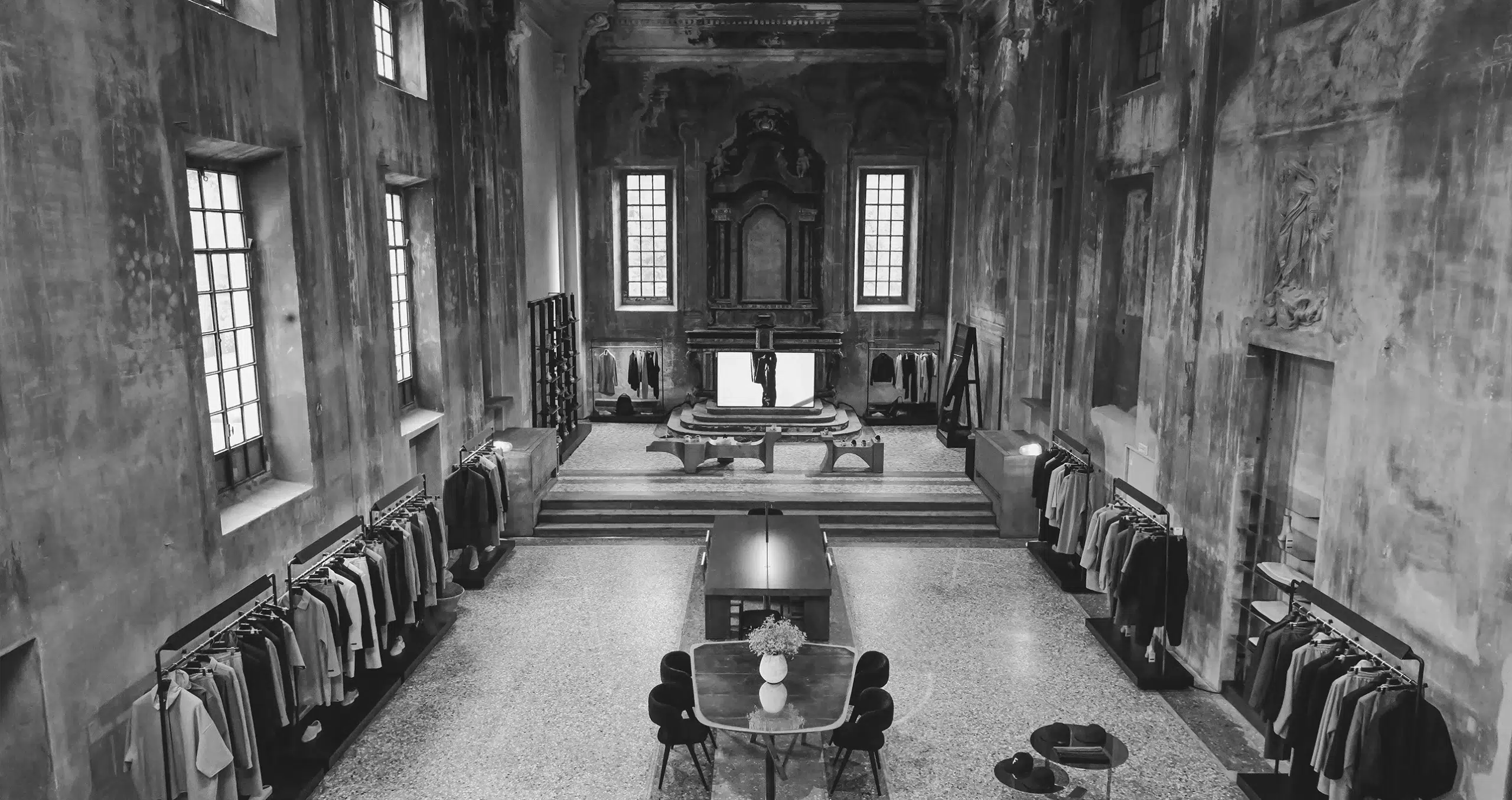
In particular, the showroom in Milan, set up in the Church of San Vittore al Corpo on the occasion of Milan Fashion Week 2024, tells the brand’s philosophy: a silent and contemplative luxury. Also the pop-up store in London at Harrods continues the same narrative, embodying the perfect synthesis of design, technology and craftsmanship.
Aesthetic language and brand identity
In the luxury retail, form is substance: visual language defines the perception of value. Color palette, light, and proportion are not just aesthetic choices, but narrative tools.
For Fear of God, the design arises from the dialogue between spirituality and modernity. Neutral tones, textural surfaces, pure geometries and rigorous proportions build a contemplative atmosphere. The Milan showroom, housed in the Church of San Vittore al Corpo, transforms a sacred place into a temple of minimalism: theluxury retail architecture meets contemporary spirituality.
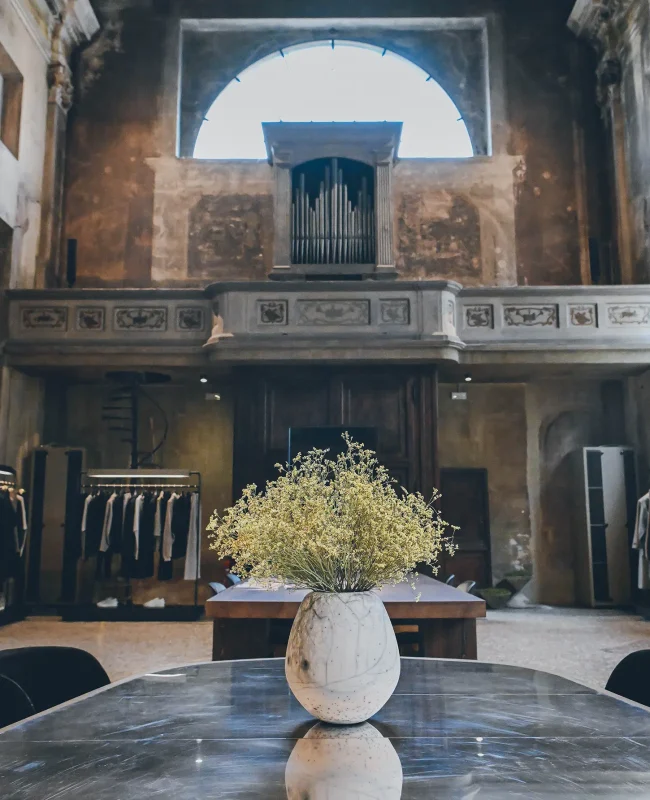
The custom-made furniture, such as monolithic solid wood tables and metal hanging structures, are designed as functional sculptures. Each element reflects an essential yet dense aesthetic. The empty spaces become an active part of the design, fostering a slow, meditative experience typical of emotional retail.
Ennobling and value perception
In high-end retail, the perception of value arises from a sum of consistent choices. Authentic material, craftsmanship and architectural precision combine to build a sense of exclusivity.
Fear of God’s Milan showroom is a virtuous example: solid wood, satin-finished metal, sheet metal surfaces and natural fabrics define a warm and rigorous environment. Construction quality and attention to detail express the soul of the interior design for luxury fashion, where every joint and finish tell the story of the pursuit of perfection.
The choice of the Church of San Vittore al Corpo as a venue amplifies the symbolic value of the project. Historic architecture becomes part of the brand narrative, elevating the setting to a cultural experience. It is the dialogue between sacred and contemporary, between light and matter, which builds a high-end customer experience.
The technical and plant dimensions of luxury
Behind the apparent simplicity of a luxury exhibition space considerable technical complexity is hidden. Thermal, acoustic, and lighting comfort are key to generating well-being and enhancing products.
Scenic lighting
In high-end showroom design, light is the main tool for shaping space. Following retail design best practices (LoveThatDesign, Alcon Lighting), a proper balance of ambient, accent and decorative lighting ensures high color rendering and material enhancement. Fear of God’s warm, controlled light emphasizes textures and creates visual depth.
Invisible comfort and climate control
Technology becomes an element of discreet comfort. Integrated climate control systems, uniform air distribution and sound insulation ensure a quiet experience, a distinctive element of the customer experience in luxury.
Immersive technology
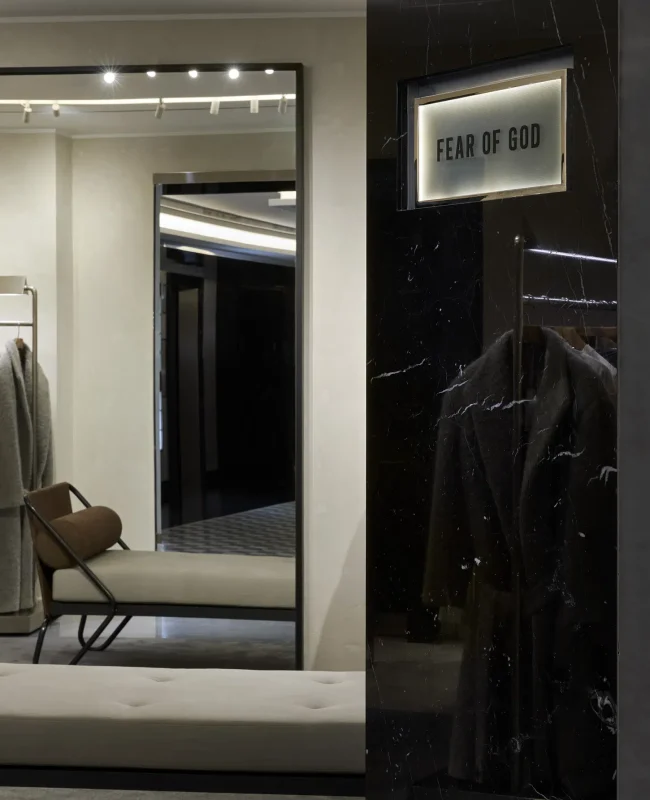
In the Harrods London pop-up, the experience is enhanced by digital and multimedia elements that dialogue with the physical environment. Technology does not invade, but amplifies: a perfect balance between innovation and aesthetic identity.
The Fear of God case: between Milan, London and Paris
The collaboration between Fear of God and Espositiva has resulted in two coherent and distinctive projects that embody the principles of high-end retail.
In Milan, the Church of San Vittore becomes a setting of light and matter, where luxury is introspection. In London, the Harrods space represents the dialogue between heritage and contemporaneity, translating the same identity into an international context.
This continuity shows that the high-end showroom design is first and foremost a matter of narrative coherence. Quality construction, precision craftsmanship and technological integration become the tools for building a emotional retail, capable of connecting brand and audience in a multisensory experience.
Conclusion
The case Fear of God shows that true luxury lies not in opulence but in consistency. L’ luxury retail architecture combines aesthetics, technique and meaning to create spaces that make brands come alive, not just show them off.
In the age of experiential consumption, the challenge of the high-end retail is to design places that speak through light, silence and matter. Fear of God perfectly embodies this balance, offering a role model for anyone who wants to interpret luxury as experience and culture.
Discover other high-end retail projects carried out by Espositiva
FAQ
What are the most commonly used materials in luxury retail architecture?
Fine woods, marble, satin-finished metals and textured surfaces combined with handcrafted finishes and natural textures that convey authenticity and warmth.
How do you create a high-end customer experience?
Through consistency between aesthetics, comfort and storytelling. Every detail-from lighting to climate control-must contribute to a smooth and quiet experience.
How does technology affect luxury retail?
Technology is an invisible extension of design. It enhances comfort and interactivity without breaking the visual harmony of the space.
Why is Fear of God a reference case in emotional retail?
Because it combines spirituality, minimalism and craftsmanship into a coherent narrative where architecture and design become tools for brand expression.
With Espositiva, every space
becomes an extraordinary experience.
