
How to position your booth within the pavilion
Why booth placement is a strategic choice
Changes in visitor behavior at the fair
Modern trade fairs are no longer simply product displays, but experiential ecosystems in which every element, from light to layout, communicates brand value. Today’s visitor is more selective, informed and experience-oriented: they plan their route, stopping where they perceive visual coherence and value. According to data from WWM, the booth placement can influence up to 60 percent of the traffic generated during the event.
Physical positioning vs. brand positioning
Position in the exhibition space is the concrete transposition of market positioning. An emerging brand that chooses a central or close to brand leader position communicates ambition and solidity. In contrast, an established company may decide to place itself in more independent areas to express authority and distinction. Every spatial choice becomes an identity statement.
Where to locate within the pavilion: high impact zones
Entrance, main corridors and passage areas
Entrance areas and main corridors are the points at highest density of passage. Attention is higher here, but competition is also greater. Booths placed along the main axes have the advantage of being seen by more visitors and being easily accessible. However, visibility must be accompanied by a clear visual message: colors, materials and proportions that make the brand instantly recognizable even from a distance.
Proximity to industry bigwigs and a trailing effect
Exhibiting near major brands can be a strategic move, especially for companies that want to increase the perception of authority. It is the trailing effect: the notoriety of big brands generates a wave of visibility that also involves adjacent exhibitors. However, it is essential to maintain one’s own visual language so as not to go unnoticed. For example, many companies in the ceramics industry at Cersaie choose locations close to the industry’s historic brands to intercept the main streams, but differentiate the booth through design and visual storytelling.
Criteria for selection: budget, goals and fair
How budget affects the choice of space
The most visible spaces-entrances, headboards, corner areas-have significantly higher costs. However, the value of these investments should be evaluated according to objectives. If the priority is maximize traffic, the expense for a premium location is justified. In other cases, an intermediate area with a more refined design can provide similar results with lower costs. A concrete example: a Vinitaly, many emerging wineries prefer secondary pavilions but invest in immersive layouts and distinctive materials that attract qualified visitors.
Types of fairs and characteristics of spaces
Each event has a different distribution logic. Flagship design fairs such as the Furniture Fair is the centrality of visual axes and the creation of experiential pathways. In industrial B2B events such as Ecomondo o SPS Italy, on the other hand, the best performing areas are those near access points and technology plazas. Studying the pavilion map in advance, analyzing the routes and historical visitor flows is the basis for a rational and strategic choice.
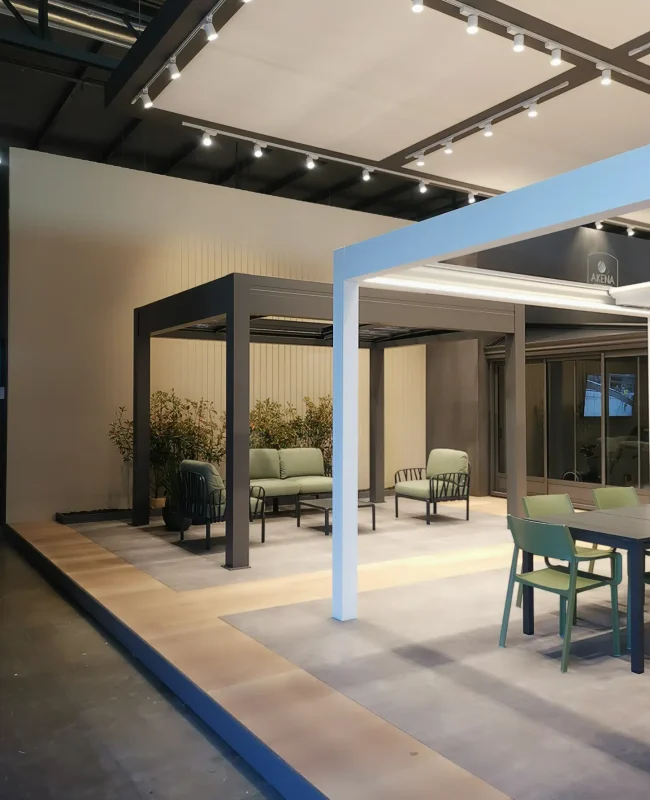
Case Study 1 - Akena at the Salone del Mobile 2025
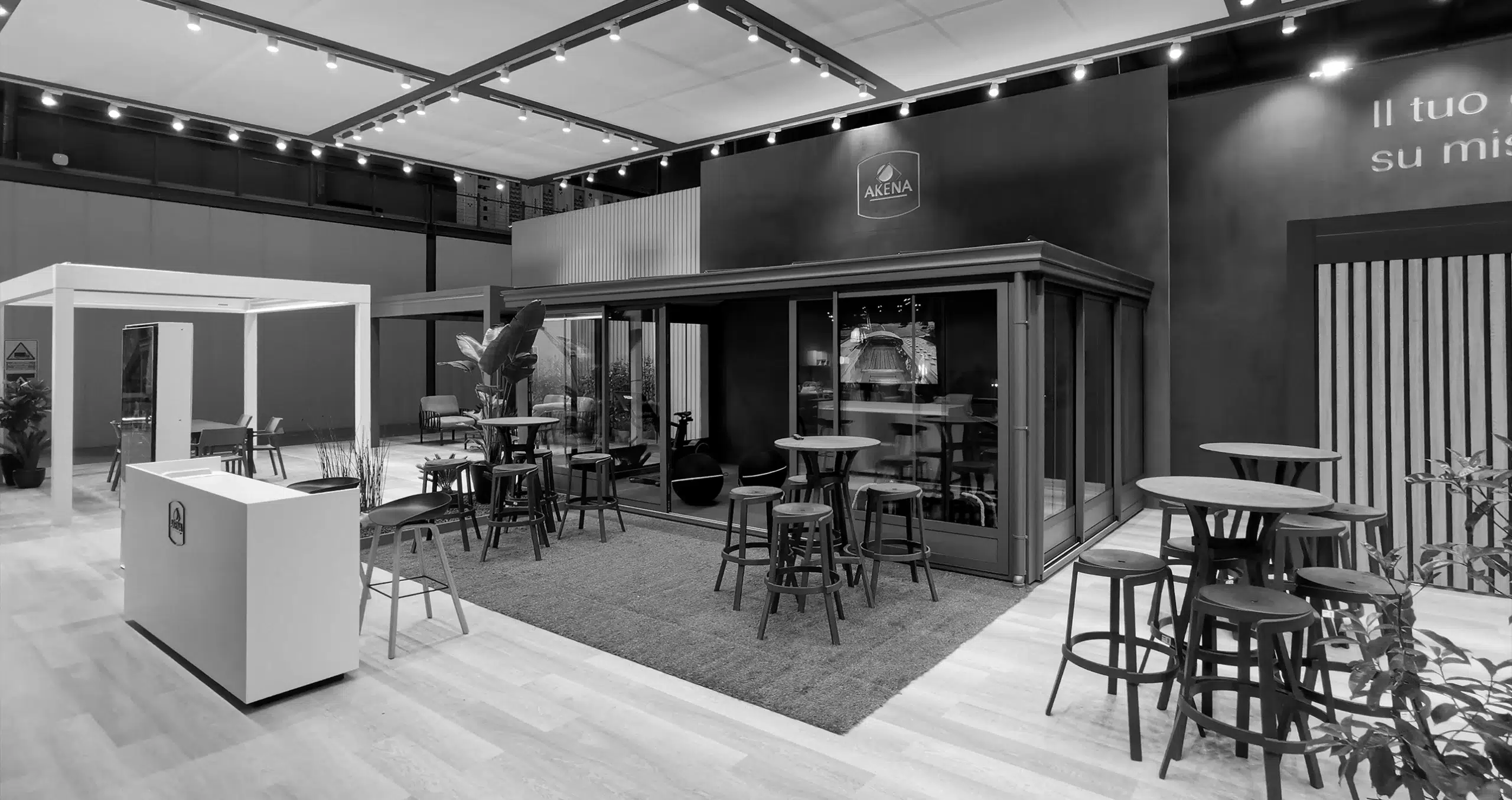
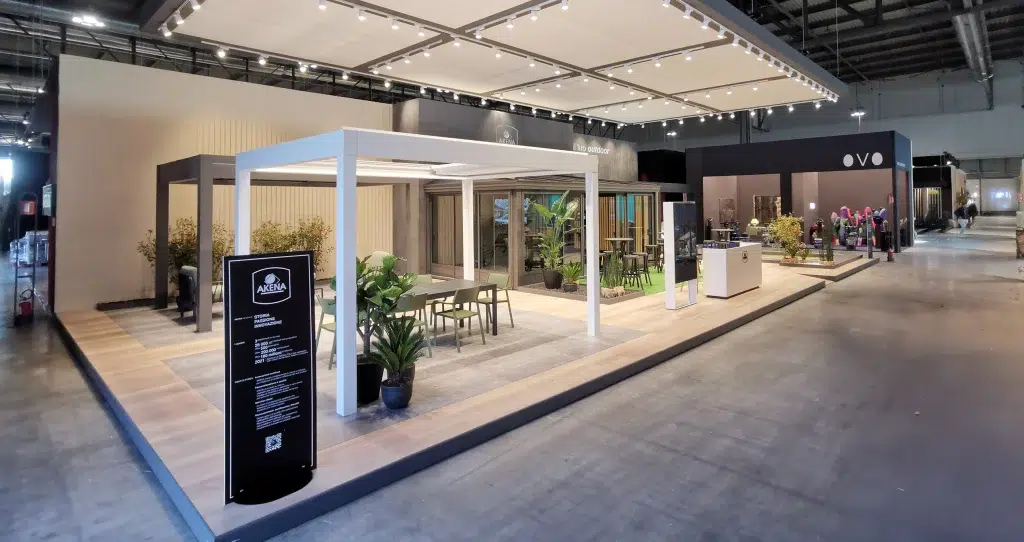
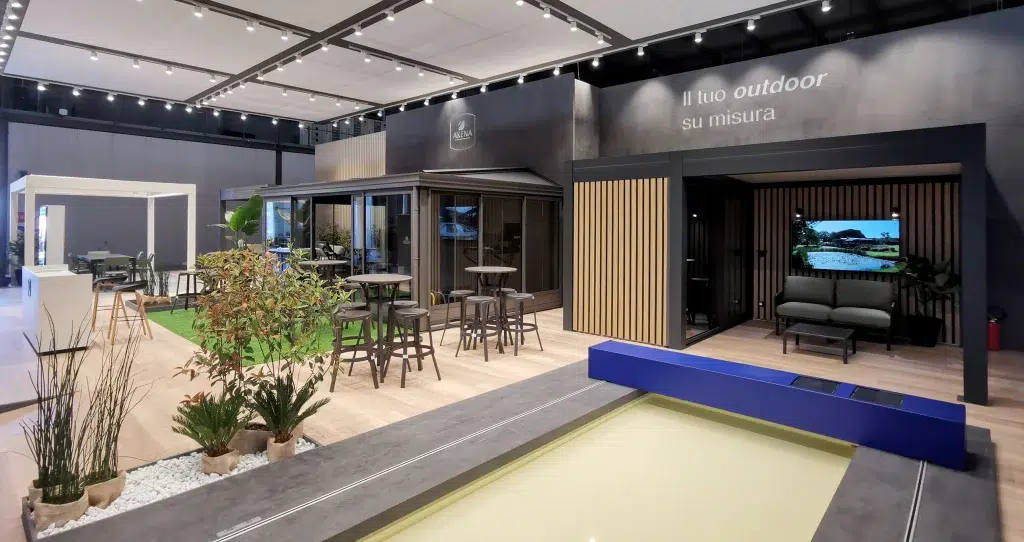
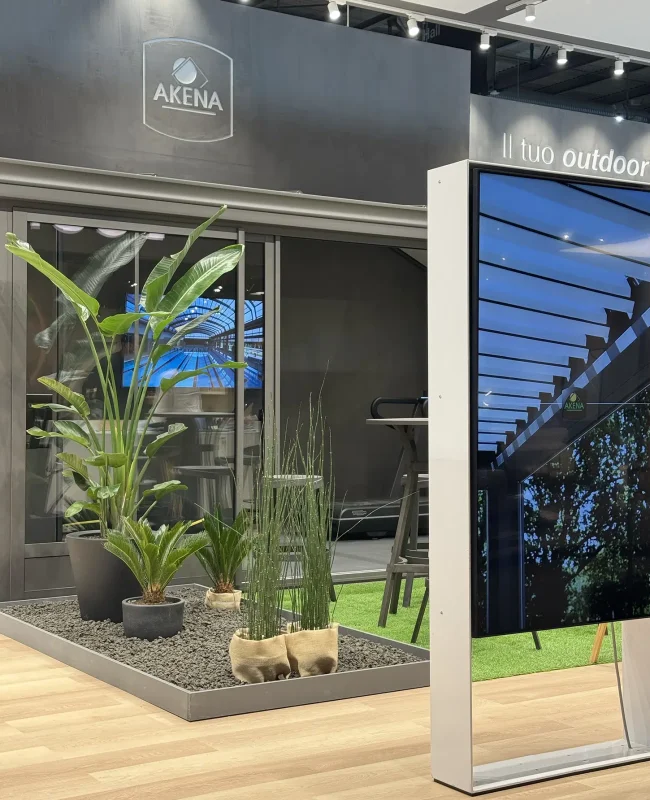
The booth Akena at the Salone del Mobile 2025 is a perfect example of spatial strategy applied to design. Positioned in a peripheral area but immediately adjacent to a major thoroughfare axis, it was able to exploit indirect visibility to maximize impact.
The project, developed on an open and immersive layout, relied on transparencies, suspended volumes and vertical lighting to generate a natural appeal. The use of light materials and warm textures helped create a welcoming and recognizable atmosphere. The result was an appealing space that combines elegance, accessibility and experiential value.
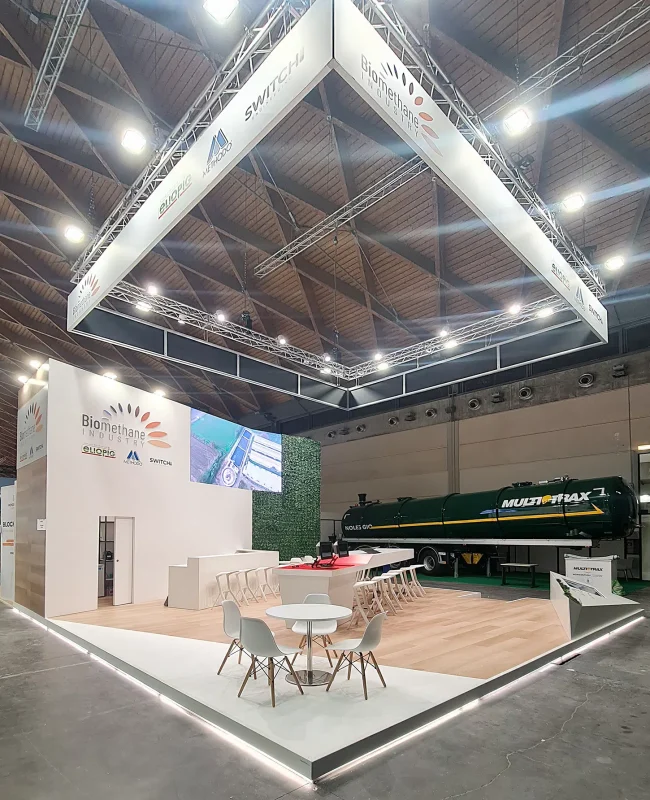
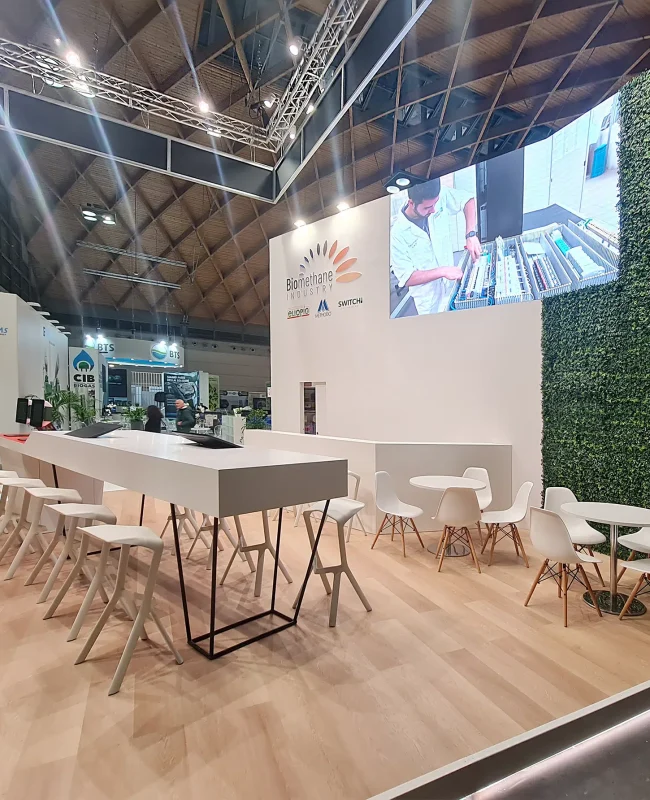
Case Study 2 - Eliopig at Ecomondo 2022
The booth Eliopig at Ecomondo 2022 demonstrates how a seemingly secluded location can become a focal point through intelligent design. Located along a side corridor, the space stood out for the 4-meter-high structure and a banner suspended at 6 meters, elements that ensured its visibility even from a distance.
The grandeur of the layout, combined with a clean, contemporary design, generated a strong visual impact. The use of vertical greenery, backlit surfaces and warm flooring created a harmonious and welcoming environment, an expression of the brand’s solidity. Despite its side location, the booth had a higher than average attendance in the exhibition area, confirming the value of design as a strategic lever.
Practical strategies for optimizing booth location
Intersections, angles and proximity to attractions
The intersections between corridors are the golden zones: ensure multiple visibility and natural convergence of flows. Corner or double-fronted booths offer the opportunity to create two entrances and display products or graphics from multiple perspectives. In addition, proximity to attractions such as Event areas, food court or networking zones increases the average time visitors stay. An effective example is that of Ecomondo, where booths placed near thematic forums consistently record visitation rates 25 percent higher than average.
Avoid "cold" areas and take advantage of the flow
Peripheral or difficult-to-access areas can penalize visibility, but not necessarily effectiveness. In these cases, it is essential to create visual attraction: directional lights, videos, installations or interactive activations that capture attention from a distance. Some exhibitors transform defiladed spaces into real target points, using a strong visual identity and direct communication (e.g., “Discover our innovation area”).
Parallelism: booth positioning and brand positioning
Being "close to the big boys" to strengthen perception
Physical positioning alongside industry leaders is a powerful branding tool. As is the case in competitive marketing, proximity to more established brands increases credibility at trade shows. Studies show that visitors unconsciously associate the perceived quality of a booth with the reputation of nearby exhibitors. Positioning oneself near the biggies is, therefore, a form of spatial co-branding that consolidates the perception of value.
When and how to choose an alternative position with its own strength
Maximum visibility does not always equal the best positioning. Some brands choose peripheral areas to create More intimate and controlled narrative spaces, where the visit becomes an experience. This is the case with some high-end manufacturers in the luxury or design sector who prefer separate pavilions to provide an exclusive environment consistent with their identity. The key is to maintain a consistency between position, objective and perception.
Conclusion: location as the first chapter of your exhibition space
Choosing a booth location is the first strategic act of any trade show participation. It is not a logistical decision, but a branding action that defines Who will see you, how you will be perceived, and what role you will play in the context of the fair. A well-designed location makes it possible to multiply contact opportunities, improve return on investment, and convey value.
As Espositiva suggests in its designs, each space must be designed from a key question: “What image do we want to leave with visitors who see us for the first time?”
The answer lies in the balance between strategy, design and positioning: Being in the right place, in the right way, to tell a story with authority.
FAQ - Trade show booth placement
1. How important is the booth location at the fair?
Very. Location influences visibility, traffic, and brand perception. Booths in central areas or along main aisles receive up to 60 percent more traffic than those in outlying areas.
2. Better to be close to big brands or in an independent area?
It depends on the goals. Being next to the big boys helps emerging brands benefit from the pull effect. Conversely, established brands can choose more independent areas to create exclusive experiences and strengthen their identity.
3. How does the budget affect the choice of location?
More visible areas have higher costs. However, it is possible to optimize the investment by choosing secondary walk-through spaces but with bright, open layouts. The important thing is to align the choice with the expected return in terms of contacts and visibility.
4. What mistakes to avoid when choosing a booth?
Disregard visitor flow or entrance direction, choose areas that are closed or too isolated, and underestimate visual competition. Every fair has “hot” and “cold” spots that need to be carefully analyzed.
5. What does “spatial positioning” mean at the fair?
It is the physical translation of brand positioning. Choosing where to stand is equivalent to deciding how you want to be perceived: close to the leaders to be recognized as a player, or on your own to communicate uniqueness and authority.
With Espositiva, every space
becomes an extraordinary experience.
